 Who Was the First Kenyon Ancestor in Rhode Island?
The Unanswered Question
The First Record of James Kenyon (?-?)
The First Record of John Kenyon (c.1657-1732)
The Purpose of this Site
The North Kingstown Bank Fire and the Damaged Town Records
The False Start as Contained in the American Kenyons
The Basic Facts
The Assumed Existence of the First John Kenyon
The Quest for Landed Gentry Status
The Yeoman John Kenyon (c.1657-1732)
The Real "Kenyon of Peel" and his Jaunt through Rhode Island
The Various Spellings of "Kenyon" and Possible English Roots
The Kenyons as they Appear in "Torrey's Marriage Index"
The James Kenyon Mill Site Grant of 1703 and the Scoundrel Elisha Cole
The Kenyon DNA Surname Project
Dead Ends
Sources
The Unanswered Question
An unanswered question that may never be answered definitively is: Who was the first Kenyon ancestor in Rhode Island? The documentary record establishes that likely brothers John and James Kenyon lived in Rhode Island in the 17th century. Some sources indicate that they were born in the colony and that their father was the original Kenyon immigrant ancestor. But no records of their births appear to exist. John Osborne Austin in his Genealogical Dictionary of Rhode Island assumed they were born in Rhode Island and assumed an immigrant father named John. (Austin) The answer to our question therefore turns on whether John and James were the second generation of Kenyons in Rhode Island or the first.
The First Record of James Kenyon (?-?)
Rhode Island genealogist James Arnold (1844-1927) in response to a request from American Kenyons author Captain Howard Kenyon wrote that "the first Kenyon that we meet in our Washington Co. records is one James in 1670 [who as] a miller had the first grant to the mill privilege where Stuart the painter was born afterward." (American Kenyons) This is the earliest reference to the Kenyon presence in Rhode Island and refers to a James, not a John.
The First Record of John Kenyon (c.1657-1732)
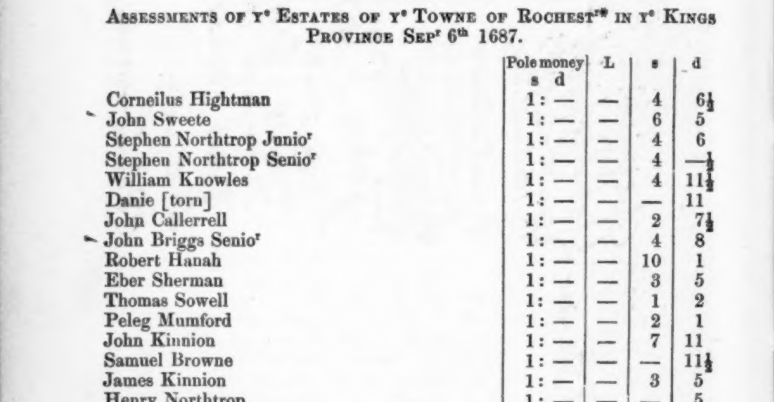
With respect to likely brothers John and James, both left a contemporaneous record through tax, property and probate documents. John and James "Kinnion" were separately taxed on September 6, 1687 as residents of Kingstown (then named Rochester). (1687 Rochester Tax Register) A transcribed copy of the 1687 Tax Register is contained in the April, 1881 issue of The Historical and Genealogical Register. John and James are listed toward the beginning of the list of 138 individuals:
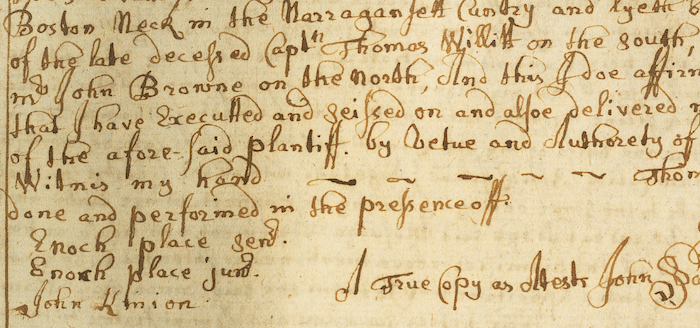
With respect to John Kenyon (c.1657-1732), the 1687 tax record has long been considered the first contemporaneous record of his presence in Rhode Island. But he appears earlier in 1677 as a witness to a property execution arising from a lawsuit. The document is significant because it is a contemporaneous record of John Kenyon's presence in Rhode Island 10 years earlier than thought and at a relatively young age. And it shows that he was already established enough in Rhode Island by 1677 to serve as a witness in a legal proceeding, indicating that he was present for some time before then. (He also testified in a later 1727 deposition that he came to live on certain land located within the Pettaquamscutt Purchase in about 1683. (History of Washington and Kent Counties and Austin).
The Rhode Island Land Records (1648-1696) at the Rhode Island state archives includes a reference to John "Kinion" at page 179. He was listed as a witness to an execution on property located in "Boston Neck in the Narragansett Cuntry," which was issued as a result of a law suit by William Clarke against the estate of John Paine of Prudence Island. The date of the execution is November 22, 1677.
"Kinion" is a recognized variant spelling of Kenyon (Kenyon One-Name Study) and the name was spelled similarly in the 1687 tax records. John would have been 20 years old at the time of signing. The required age to be a competent witness on legal documents in Rhode Island was 15. (Legal Genealogist) Aside from this identifying information, the other witnesses to the execution support the conclusion that this is the correct John Kenyon.
The witnesses were Enoch Place Sr. and Enoch Place Jr. Enoch Sr. was born in 1631 and died in 1695. (Austin) Enoch Jr. was born in 1658 and died in 1703, meaning he was near the age of John Kenyon born in 1657. (Family Search) The Places were located in Kingstown, as was John Kenyon. (Austin)
At Enoch Sr.'s death in 1695, Thomas Mumford was an overseer of his will. (Austin) This is certainly Thomas Mumford Jr. since his father Thomas Mumford Sr. died before February, 1692. (Austin) Thomas Mumford Jr. was eventually John Kenyon's brother-in-law who deeded him land in Kingstown, which John Kenyon deeded to his son John in 1712. (American Kenyons) The deed strongly supports that John Kenyon married a sister of Thomas and Peleg Mumford, who were both mentioned as brothers-in-law in the document.
John Kenyon's son James in 1716 married Mary Place, who was the daughter of Thomas Place. (American Kenyons) Thomas Place was Enoch Place Jr.'s brother. (Austin) Also interestingly, John Kenyon named one of his sons Enoch. (American Kenyons)
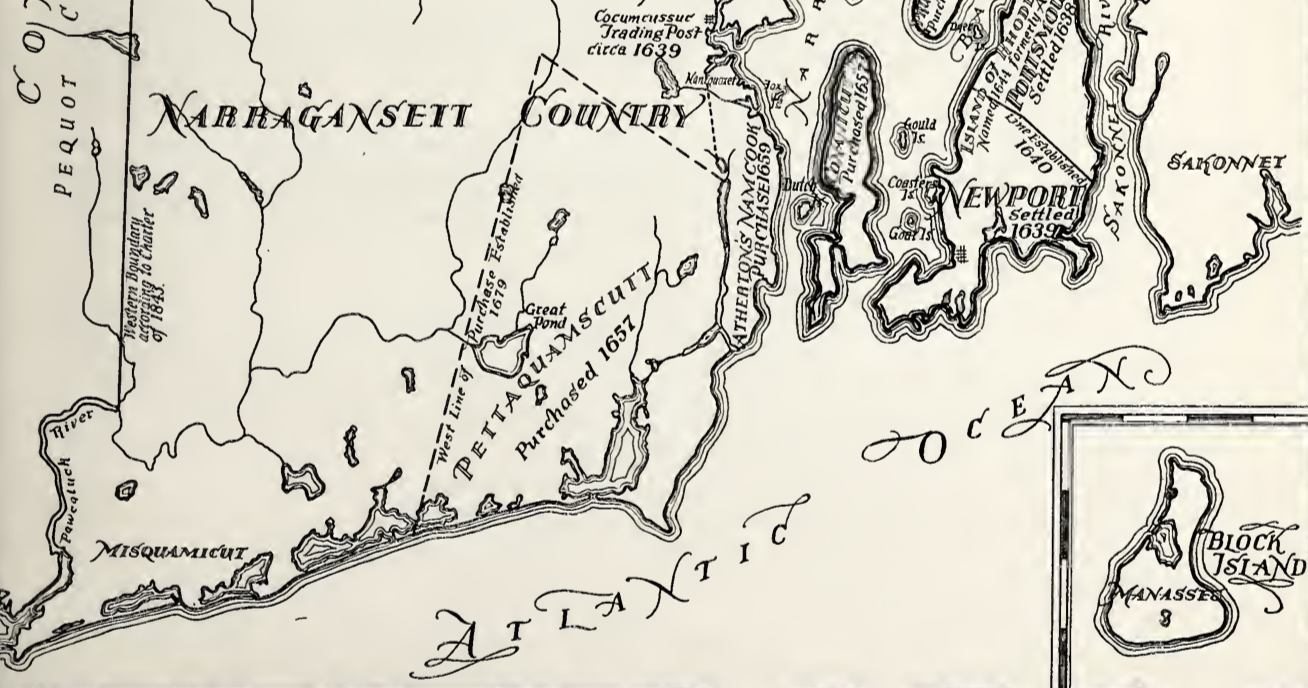
This is circumstantial evidence of course. But it is evidence of the type of connections that you would expect to see among families who were the settlers of the land encompassed in the Pettaquamscutt Purchase of 1657/58. Thomas Mumford Sr. was one of the partners in that well known land purchase in what was known then as "Narragansett Country." (Pettaquamscutt Purchase) The James Kenyon mill site referenced by James Arnold was within that area. The Rhode Island Tercentenary Commission in 1936 published a collection of maps on Rhode Island boundary changes from 1636 to 1936, including a map showing the Pettaquamscutt Purchase:
The Purpose of this SiteTop
So as it stands we have a James Kenyon who, according to Arnold, was present in Rhode Island in 1670 and a John Kenyon who was present in Rhode Island in 1677. Were they father and son? Were they brothers? Or some other relation? Or no relation at all (which would be unusual considering the small population of Kingstown at that time). Or, further, is the 1670 date reported by Arnold wrong and the James he found was indeed John's likely brother James who obtained the mill property at a later date? If so, there woud be no known contemporaneous documents referring to a John or a James Kenyon who could be the brothers' father.
The question of the first Kenyon ancestor thus implicates a possible father named John or James and possible sons John and James. This site is an attempt to include in one location all information available on the topic from a number of genealogical resources and by links to copies of original documents where possible.
The North Kingstown Bank Fire and the Damaged Town RecordsTop
Research on the Kenyons in Kingstown is encumbered to a degree by a December 15, 1870 bombing and subsequent fire that damaged or destroyed the town records of North Kingstown. Kingstown was divided into North and South Kingstown on February 26, 1722/3, with North Kingstown retaining the founding date of 1674. (Town of North Kingstown) Bank robbers attempted to blow up the vault at the Wickford National Bank in North Kingstown where the town records were stored. (History of Washington and Kent Counties) The robbery was unsuccessful, but the fire damaged or destroyed the town records. (Wickford National Bank) For some of the records, the record book covers were burned and the pages burned around the edges. What remained was rebound. (Probate Records) (The year of the fire is recorded variously as 1869 (Arnold Washington County), 1870 (History of Washington and Kent Counties) or 1871 (Probate Records) - 1870 seems to be accurate based on a review of the records.)
Arnold when reviewing the North Kingstown records in 1881 stated that "[t]he books, or what remains of them, were so badly burnt and pages become so disarranged that it has become impossible to give original book and page, as it is in other towns, and hence are omitted here." (Arnold Washington County) Arnold was nonetheless able to record 107 pages of marriage, birth and death statistics from the damaged town records. The damaged North Kingstown land records still exist, although they are badly burned around the edges. They can be viewed at FamilySearch.
When it comes to the records for land in the old Kingstown that became located in South Kingstown after 1722/3, the bank fire should have no effect on the ability to research those properties. When dividing the town, the Assembly made provision for those records to be copied: "And that the Records of the late Town of Kingstown be put into the hands of the clerk of North Kingstown, to be and remain in said North Kingstown; and that a copy of all Records belonging to South Kingstown, to be drawn out of the Records of the late Kingstown, and to be delivered to the clerk of said South Kingstown, when chosen, and to be paid for out of North and South Kingstown treasuries." (Arnold Washington County)
The False Start as Contained in the American KenyonsTop
Captain Howard Kenyon’s book American Kenyons published in 1935 looms large in Kenyon genealogy. Through exhaustive research he was able to correctly identify generations of Kenyons descending from Rhode Island roots. He committed a fundamental error, however, when it came to identifying the English roots of what he described as the First and Second Generations in Rhode Island.
Based on Arnold’s letter referring to James as the first Kenyon mentioned in "our Washington Co. records," he engaged researchers in England to search for a family with a father James and sons John and James. The researchers found such a family, but genealogists have proven that this family did not emigrate to Rhode Island.
The family he found was James Kenyon (b. 1633) who married an Ester Smith (b. 1633) at Oldham Parish Church, Lancashire on May 2, 1654. After marriage they resided in Glodwick. They had two sons, John, born April 26, 1655 and James, born July 4, 1657. (American Kenyons) According to records, John, with a wife named Anna, had a son John baptized at Oldham on December 26, 1682 and a daughter Sarah baptized there on February 22, 1684. (American Kenyons)
Simply by studying these dates and others known to him at the time, Captain Kenyon should have seriously questioned whether his research had found the correct English immigrant family. He knew that John Kenyon testified in a 1727 deposition that he started living on land in the Pettaquamscutt Purchase in 1683. Is it reasonable to believe that he emigrated to Rhode Island not long after the birth of his first child when his wife was pregnant with their second, leaving them to travel on their own to the colony in early 1684? (American Kenyons) Moreover, what of assumed father James’ presence in Rhode Island in 1670 according to Arnold? Captain Kenyon posits that James and his son James arrived in Rhode Island at or about that year. (American Kenyons) So did James abandon his son John at age 15, travel with 13 year old son James to settle in Rhode Island and wait for John to emigrate years later? The timeline is not rational.
Captain Kenyon in American Kenyons does not indicate that he was aware of the 1677 Rhode Island property execution with John Kenyon as a witness, although the original handwritten record was contained in Volume 1 of the Rhode Island Land Records at the Rhode Island State Archives. The document was also printed in abstract form in Rhode Island Land Evidences, Volume I (1648-1696) Abstracts, a widely available 246 page book published in 1921 by the Rhode Island Historical Society. (See Abstracts at pp. 128-129.) The purpose of the Historical Society publication was to bring these deeds "before students and historians in a reasonably convenient form." (Abstracts) The 1677 document undercuts any notion that the John Kenyon of Glodwick and the John Kenyon of Rhode Island were the same person.
Gerald Parsons in The American Genealogist, Volume 78 (2003), reviewed the English origins of John and James Kenyon as stated in the American Kenyons. In reviewing additional information from the Oldham Parish records and Rhode Island land records, certain incongruities lead him to believe that a possible scenario was that “the John Kenyon of Glodwick may very well not be the Rhode Island man.” Volume 78 at p. 226. A year later The American Genealogist published a follow-up article proving that to be the case. Michael Woods in Volume 79 (2004) at page 207 explained that in searching later Oldham parish registers he found the burial dates in England for brothers John and James and John’s wife Anna. The family never left Glodwick. It is also notable that each English record reviewed by Parsons and Woods used the “Kenyon” spelling of the last name and not the "Kinnion, Kinion or Kinyon" spelling found in the early Rhode Island records.
The error almost immediately affected the way genealogists studied the original generations of Kenyons in Rhode Island. Captain Kenyon concluded that John Kenyon married an Anna Mumford based on the English record showing the Glodwick John married an Anna and the 1712 deed indicating the Rhode Island John married a Mumford. But Meredith Colket pointed out in The American Genealogist, Volume 13 (1936) that the Mumford family had been in Rhode Island since 1650 and Sarah Sherman, Thomas Mumford Sr.'s wife, was born in Massachusetts in 1636. Colket rightly noted: "The author of the Kenyon genealogy has failed to explain how an Anna Mumford whose father was in America since 1650, whose mother was born and died on this side of the Atlantic, and whose maternal grandparents lived in Massachusetts and Rhode Island, came to be the mother of two children baptized in Lancashire, England." Volume 13 at p. 54. But, instead of concluding that Captain Kenyon was wrong in finding that the John Kenyon of Glodwick and the John Kenyon of Rhode Island were the same person, Colket surmised that he must have married an Anna in England and then married a Mumford in Rhode Island as a second wife.
Captain Kenyon’s fundamental error in identifying the Rhode Island emigrant Kenyon family has been repeated countless times since the book’s 1935 publication. Many family trees online continue to copy the erroneous information on the origins of the First and Second Generations of the Kenyon family in Rhode Island. His book has the partial subtitle “History of Kenyons and English Connections of American Kenyons.” Captain Kenyon seemed so intent on proving those connections that he was willing to overlook obvious difficulties with the timeline he presented.
The Basic FactsTop
The basic facts on when the Kenyons may have arrived in Rhode Island come largely from John Osborne Austin in his 1887 book Genealogical Dictionary of Rhode Island at page 116. The documented facts include the September 6, 1687 Rochester (Kingstown) tax register recording taxes paid by John and James noted above. Austin also cited an August 28, 1727 court deposition at Westerly, where John "calling himself aged seventy years, or thereabouts, testified that in the year 1683, or thereabouts, he went to live on the farm that Stephen Northup of North Kingstown now lives on and paid rental to Major Smith in behalf of Mr. Killum of Boston, and lived there for eight years, and Stephen Northup went in when he left it." From this Austin calculated John's birth year as 1657. He was unable to find a documented birth year for James Kenyon. Austin was also clear that he assumed John and James were brothers and that a John was their father and the first immigrant ancestor.
The calculated birth year for John Kenyon of 1657 based on his deposition testimony is the best evidence of his actual birth year. But there are still references to John Kenyon being born in 1655 based on Captain Kenyon identifying the wrong Kenyon immigrant family and thus the wrong John. The American Kenyons has caused additional confusion by inaccurately transcribing the date of the deposition as "August 8, 1717," which results in a calculated birth year of 1647, rather than 1657.
Since the publication of Austin's book, along with Arnold's 1670 mill reference and the 1677 property execution, a 1684 court case involving assumed brother James has been found. (Kenyons of Cattaraugus) This is the first contemporaneous record of this James' presence in Rhode Island. The case concerned a paternity claim against James filed in Newport. An abstract of the case is contained in Rhode Island General Court Trials, 1671-1704 by Janet Fletcher Fiske and is available here through FamilySearch.
This seems to be the extent of the information that has been uncovered concerning the Kenyons' arrival in Rhode Island.
The Assumed Existence of the First John KenyonTop
Austin's Genealogical Dictionary of Rhode Island is a significant achievement. Austin set out to document the first generations of families who settled Rhode Island before 1690 and he succeeded to a great degree. Simply reading the individual entries, which were typically based on wills, land records, court cases, correspondence and government documents, gives a detailed picture of the life of early settlers in Rhode Island. The strength of his book is that it relies on documented facts when it identifies and discusses individual settlers. This is particularly the case for the first generation of settlers, some of whose documented entries run on to multiple pages. But what is important to bear in mind when considering the first Kenyon in Rhode Island is that the only first generation entry in the entire book that does not include at least one documented fact is John Kenyon's:

Austin assumed John Kenyon into existence and then assumed he was the father of John and James. While there are other occasions in the book where the father/child relationship is assumed, those are based on a documented settler who is the assumed father of the next generation based on a common name and location and logical dates of birth.
The Quest for Landed Gentry StatusTop
The lack of documentary evidence on the English origins of the Kenyons in Rhode Island did not prevent certain late 19th and early 20th century publications from presenting sometimes elaborate descriptions of the Kenyons' purported roots. J.H. Beers & Co. published Representative Men and Old Families of Rhode Island in 1908. The four volume set reviewed genealogical records and historical sketches of "prominent and representative citizens and of many of the old families." The general format provided brief biographies of then living residents of Rhode Island, including their family histories. A number of Kenyons are included in the book, most with their own version of the Kenyon family history. An interesting chore is to sift through those histories to determine what information may be reliable.
The entry for Elijah Kenyon states he was descended from John Kenyon of Kingstown and his son John Kenyon who was born in 1657 and died in 1732. The entry refers to the son's sworn statement as evidence of his birth year. This information on the first two generations is thus straight from Austin. The entry also claims that the "establshed progenitor, John Kenyon of Kingstown" was "descended from the Kenyons of Peel, Lancaster." This claim to landed gentry origins of the Kenyon family in Rhode Island appears throughout this book, and others, and will be discussed below.The entry for James Stanton Kenyon relies wholly on Austin's recitation of the first three generations of Kenyons in Rhode Island, but in an apparent typographical error lists son John's birth year as 1637, rather than 1657. The entry for George H. Kenyon states he descended from John Kenyon's son James, with the "progenitor" John Kenyon of Kingstown as "descended from the Kenyons of Peel, Lancaster."
John L. Kenyon has the most genealogical sound entry. His states: "The first authentic record of the Kenyon name in Richmond [once part of Westerly] is one of John Kenyon, who came from North Kingstown. From his own sworn statement he was born in 1657. His death occurred in the year 1732." Again this is information from Austin. The entries for Charles L. Kenyon and Charles H. Kenyon similarly include only information on the early Kenyon family history contained in Austin.
The most ambitious Kenyon family history is that attached to William G., William A. and Orrin P. Kenyon. To give a sense of its likely accuracy, the information on John Kenyon (1657-1732) states: "He married Sarah Gray. (If this is correct, she was the . . . grandaughter of John and Mary (Chilton) Winslow . . . . This gives a direct "Mayflower" line to the descendants of John Kenyon.)." Needless to say this is not correct since the evidence is strong that John Kenyon married a daughter of Thomas Mumford Sr. Moreover, the actual Massachusetts marriage of Sarah Gray to Samuel Little in 1682 is well documented. WikiTree Gray-1190.
Not only that, this Kenyon family history has not one, but two John Kenyons preceeding John Kenyon (1657-1732) in Rhode Island. First, John Kenyon born in 1605 who married Ann Smith in about 1625 or 1630 and was directly descended from "Jordan de Lanton, Lord of Kenyon of the reign of Henry III of England" and of "Peel, Lancaster, England." Second, his son, John Kenyon born in 1636, who married first Hannah Sheppard and second Mary Rigby. What is to be made of this Kenyon history where the early Kenyon immigrants to Rhode Island were not only direct descendents of ancient English landed gentry, but conveniently married into what, by the early 20th century when this book was published, had come to be regarded as American colonial royalty? A hint may be contained in the book's preface where the publishers state: "In nearly every instance the data were submitted to those immediately interested for revision and correction." (Preface) William G., William A. and Orrin P. were no doubt proud of their early American family history, accurate or not.
Representative Men and Old Families of Rhode Island when documenting Kenyon family histories cites on a number of occasions the multi-volume book American Ancestry: Giving the Name and Descent, In the Male Line, of Americans Whose Ancestors Settled in the United States Previous to The Declaration of Independence A.D. 1776. Volume I of that book published in 1887 has an entry for Ralph Wood Kenyon who claims he was descended from Joseph Kenyon (m. Sarah Paine) who was the "son of John Kenyon and Ruth, his wife, who came from England to America about 1695, and (with his brother James, who landed at Portsmouth, Rhode Island sometime previous) claims to be descended from Jordan de Lanton, Lord of Kenyon, of the reign of Henry III, King of England."
The information included in American Ancestry seems to be based entirely on the self reported family histories of the book's subjects. Volume I includes a handy form at the back for those who missed out on the initial publication to submit their genealogies. Discerning anything of genealogical value from Ralph Wood Kenyon's submission as concerns the early Kenyons is difficult. There was a Joseph Kenyon who married a Sarah Paine, but this was Enoch Kenyon's son and John Kenyon's grandson, not son. WikiTree Kenyon-1365. Then again John Kenyon's son Joseph married a Paine, but her name was Marcy. WikiTree Kenyon-50. And Ralph Wood's ancestors appear to descend from this union and not the Joseph Kenyon/Sarah Paine union.
Continuing on, the first name of John Kenyon's wife is unknown, but could it be Ruth? Or is it more likely that through a generational game of telephone James Kenyon's wife Ruth Wells Kenyon became attributed to John Kenyon? WikiTree Wells-1841. The 1695 immigration date is obviously wrong based on the documentary evidence cited above. Perhaps the only information of signifigance is Ralph Wood's understanding that John and James were brothers, were immigrants and that they did not emigrate to the colonies at the same time. This is the type of broad detail that could be passed down generation to generation uncorrupted.
Since American Ancestry and Austin's Genealogical Dictionary of Rhode Island were both published in 1887, it seems unlikely that Austin's book had any influence on the Ralph Wood Kenyon entry, which seems to be based on family history, not genealogical research. Notably, Ralph Wood's history of the family in Rhode Island began with John Kenyon (1657-1732) and not an assumed father John. Perhaps this is another indication that Austin's assumption is not a solid one.
Coincidently, American Ancestry includes in Volume VI an entry for John Osborne Austin on the same page as an entry for Ralph Wood Kenyon. The entry states that Austin "engaged in the wool business 1866-83, has been occupied the last seven years in preparing and publishing genealogical works, author of 'The Genealogical Dictionary of Rhode Island,' visited Europe and Cape Colony, Africa, walking six hundred miles to the Diamond Fields." He seems to have been as obsessed with walking to diamond mines in Africa as he was with gathering genealogical documents in Rhode Island.
Another early 20th century publication providing genealogical information is the six volume The History of the State of Rhode Island and Providence Plantations published in 1920. The last three volumes are devoted to biographcal sketches with family histories, some of which are clearly from Representative Men and Old Families of Rhode Island, and none of which include additional information on the first Kenyons.
The publication includes a section on the "Kenyon Line." The 13th century roots of the Kenyon family in Lancaster are again invoked with "one of its most notable and historic branches being the Kenyons of Peel, to whom many authorities trace the ancestry of the founder of the American family, John Kenyon, who it is claimed was a lineal descendent of Jordan de Lanton, lord of Kenyon, in the reign of Henry III, of England." (No doubt we have just reviewed above the identity of these "many authorities.") The entry continues to state that the "American branch was established prior to the middle of the seventeenth century." John Kenyon is listed as the immigrant ancestor who was born in England in 1605, married Ann Smith in 1627, and came to the colonies at an unknown date. John (1657-1732) and James Kenyon are listed as his sons. This entry thus tracks the William G., William A. and Orrin P. information concerning the immigrant ancestor John Kenyon born in 1605, but dispenses with the intermediate John Kenyon born in 1636.
The entry for James Stanton Kenyon tracks his entry in Representative Men and Old Families of Rhode Island and repeats the typographical error listing John's birth year as 1637, rather than 1657. But here this results in Austin's assumed father John and John (1657-1732) collapsing into one person, no doubt to maintain a rational timeline. The just-the-facts entry of John L. Kenyon is the same as his entry in Representative Men and Old Families of Rhode Island. The entry for John Jesse Kenyon extolls the grand history of "Jordan de Kenyon" and the Kenyons of Lancashire, but otherwise follows Austin's facts. The entry for Grafton Irving Kenyon provides the same information as the ambitious entry of William G., William A. and Orrin P., but dispenses with any notion that the "Mayflower" ancestry could be incorrect. Comparing the entries between these two publications, aside from determining whether there is any new information, shows how errors can multiply and nuance disappear in genealogical writing in the span of just 12 years.
Who was "Jordan de Lanton" and who were "the Kenyons of Peel?"
By most accounts Jordan de Lanton or Launton was the first of note to bear the Kenyon name. The name derived from village of Kenyon in Lancashire that was located on land owned by Jordan's father William de Lauton. (Kenyon One-Name Study) William gave the village of Kenyon to his son by 1256 and Jordan then changed his surname to Jordan de Kenyon. Kenyon was located within the parish of Winwick. The "Kenyons of Peel" were directly descended from Jordan de Kenyon. (Kenyon Biography)
The Yeoman John Kenyon (c.1657-1732)Top
Reviewing the Rhode Island documents, how likely is it that John Kenyon (c.1657-1732) was the scion of the landed gentry of Peel Hall? Surprisingly, given the limited number of relevant documents, the answer appears evident. John was both a self-described yeoman and used a mark instead of signing his name. Both characteristics essentially preclude finding that he descended from the Kenyons of Peel Hall.
John Kenyon's class status as a yeoman is included in the Rhode Island documents. In the opening preamble to both the 1712 land transfer to his son John and his will, he identifies as a "yeoman." A yeoman was a landholder who worked his own land, often with hired labor. In modern class terms, they were members of an often prosperous rural, middle class. The gentry on the other hand "were countrymen, living on their estates in houses of some note and distinction and deriving much of their means from the rents of farmland." (The Gentry at p. 2.) While there may have been little distinction between the lowliest member of the gentry and the wealthiest yeoman, and while there were significant class distinctions within the gentry, gentry and yeomanry were recognizable social classes. John Kenyon understood that he was a yeoman and not of the gentry.
"[T]he yeoman were, in the main, an inarticulate group" and "were better judges of sheep and seed corn than of words and phrases, and certainly more skilled in the tools of husbandry than the pen." (The English Yeoman at p. 4.) The rate of literacy of the gentry on the other hand was virtually 100% because of the skills required to administer the vast holdings of a rural estate. (The Rabble) While there was not an exact correlation between the use of a mark, which indicates a lack of training in handwriting, and the ability to read, John Kenyon's use of a mark does indicate the lack of a formal education in reading and writing, which education would have been normal for the gentry. John's assumed brother James also used a mark and John Kenyon's youngest son Jonathan Kenyon was still acknowledging legal documents with a mark throughout his lifetime, including his will of 1766. Nevertheless, over time, New England colonial yeomen did become known for their comparatively high standard of literacy.
While the issues of class and education give a compelling answer to whether John Kenyon was descended from the Kenyons of Peel Hall, the timeline provides perhaps an even clearer answer. While the "Kenyons of Peel" may have appeared of ancient lineage to successful American Kenyons of the late 19th and early 20th centuries seeking evidence of their fancied elite roots, that was not the case for those in mid-17th century England. The "Kenyons of Peel" as such did not exist until Roger Kenyon II prevailed in his legal battles with the Rigby family in the early 1660s. The descent from the "Kenyons of Peel" thus began with Roger Kenyon II at that time. There is no doubt that John Kenyon (c.1657-1732) was not a son of Roger Kenyon II. Aside from the fact that he was born in the same year Roger Kenyon II and Alice Rigby wed, the children of Roger Kenyon II are well documented, and do not include a John (or a James). (FamilySearch)
The Real "Kenyon of Peel" and his Jaunt through Rhode IslandTop
On July 22, 1683, Roger Kenyon II while at Peel Hall received a letter dated May 30, 1683 from his eldest son Roger Kenyon III. The letter was posted from "Road Island" and is described by the National Archives as "begging his father to redeem him from service to Mr. Nath. Coddington, [and] tell[ing] of his travels from Barbados to New London and Road Island." (National Archives). The letter is no longer available at the Lancashire Archives, where it was held, but Roger III's travels through the colonies can be pieced together from other correspondence and documents.
Roger III's saga began when he sailed in 1681 from Ireland to Barbados to trade a small cargo given to him by his father. Barbados at that time was an enormously profitable center of English colonialism because of its sugar plantations. By the early 1650s, "the island's value, in terms of trade and capital generation, was greater than all the other English colonies put together." (The Origins of Empire at p. 225) But Roger III did not fare well there due to sickness. He became considerably in debt and entered into an indenture to clear it, apparently with Nathaniel Coddington. Coddington was a son of William Coddington, who had been governor of Rhode Island, and likely crossed paths with Roger III as a participant in the lucrative provisioning trade with the West Indies. "Rhode Island dominated this trade, operating, in essence, as the commissary of the Atlantic plantation complex." (Slave Trade)
Reports were that Roger III left Barbados for New York where he was going to tutor "gentlemen's children" for two or three years "by covenant with a gentleman there." (The Heir) This report was apparently mistaken because he ended up instead on Block Island, where he made the acquaintance of a Captain Shapley, who reported to the family in August, 1683 that Roger III works everyday "to carry timber from the water side to make fences" and "has noe more for his day's work than meat and drink." (Kenyon Manuscripts) Roger II made arrangements with Captain Shapley to retrieve his son, who was expected to be in Plymouth in March, 1683/4, but he could not be found, even in the town jail. (Kenyon Manuscripts)
Roger III's absence from Plymouth was understandable because he had married Mary Ray of Block Island on October 11, 1683 and they had a son Roger on January 23,1684/5. Mary Ray was the daughter of Simon Ray, a wealthy land owner and founder of Block Island. Roger III and Mary traveled to England later in 1685, staying at Peel Hall. A grand-niece reported many years later that Mary Ray Kenyon was the "first American Lady presented at Court and kissed the King's hand." (The Heir) The pair returned to the colonies, but Roger III returned to England thereafter and eventually to Ireland where he died.
So that is the story of Roger of Peel Hall and his Rhode Island connection, which has no real relevance to the Rhode Island Kenyon genealogy - except for an error Austin made in the Genealogical Dictionary of Rhode Island. Austin likely relied on three records to conclude that John, James and Roger III were brothers because they were first recorded as present in Rhode Island at about the same time. One was the only record of Roger Kenyon in Rhode Island, which was a notation made in the New Shoreham records of Roger and Mary's marriage and the birth of their son Roger. Many years later when son Roger was apparently documenting his descent from the Kenyons of Peel Hall for inheritence purposes, the clerk who actually made the entry testified that Roger III requested it so that his son would be in the position to prove his descent and inherit his estate. The remaining two documents were John's testimony that he began living on certain land in Kingstown in 1683 and the tax register showing John and James were taxed at Kingstown on September 6, 1687.
Austin's error was eventually corrected in the April, 1943 issue of the American Genealogist, but it is a cautionary tale that these few documents alone apparently lead Austin to conclude that John, James and Roger were brothers. While the additional contemporaneous documents concerning John and James are certainly not voluminous, they at least show a continuous presence in Rhode Island until their deaths. That was not the case with Roger III, whose fleeting presence in Rhode Island lead to a single record, and even that was only because he insisted for reasons of his son Roger's potential inheritence.
Captain Kenyon was enamored of the saga of Roger III and spent pages describing it in American Kenyons. Although he did not conclude Roger was directly related to John and James, their sharing a name and Rhode Island presence was enough for him to include an imposing portrait of the first "Lord Kenyon, Baron of Gredington," who was described as "Grandson of Thomas Kenyon, brother of Roger Kenyon who settled Block Island, R. I." (American Kenyons). Or in other words, the portrait of the grand-nephew of an unrelated Kenyon who once spent some productive months on Block Island.
The Various Spellings of "Kenyon" and Possible English RootsTop
We've seen that the last name of the early Rhode Island Kenyons was variously spelled Kinion, Kinnion or Kinyon. The apparent inability of the early Kenyons in Rhode Island to write their last name may have contributed to the various spellings found in the early colonial records. Whether it was spelled Kinnion, Kinion or Kinyon depended on the ear of the recorder. The "Kinyon" spelling seems to have become preferred in the early 18th century. Meanwhile, the Kenyons of Peel Hall had long since used the standardized "Kenyon" spelling of the name.
This "Kenyon" spelling is reflected in the 1684 Block Island record of Roger III's marriage and birth of his son. His son Roger eventually had extensive land owning and business activity in North Carolina where he exclusively used the "Kenyon" spelling at a time when the Rhode Island spelling was still in a flux. A particularly clear example is a 1727 promissory note that he signed as "Roger Kenyon" and without using a mark. A fascinating instance is from New Jersey where property records show he was resident for a time. He was to captain the cargo ship URSULA from Perth Amboy to North Carolina and his August 13, 1718 voyage orders were addressed to "Captain Kinion," but his acknowledgement was as "Roger Kenyon."
The standardized spelling of Kenyon was not limited to descendents of the Kenyons of Peel Hall. The early Kenyons of Virginia used the standardized spelling. Abraham "Kenyon" was an active litigant in 1684 Essex County, Virginia. His son John Kenyon acknowledged legal documents as John "Kenyon" without a mark.
These records tend to show that if an immigrant was a "Kenyon" when they left England, chances are they remained so in the colonies. John and James Kenyon may have descended from a line of Kenyons in England who had not yet standardized the spelling of their last name, which may narrow the universe of possible English ancestors.
The Kenyons as they Appear in "Torrey's Marriage Index"Top
New England Marriages Prior to 1700 by Clarence A. Torrey (1869-1962) is often referred to in shorthand - whether as "Torrey," "Torrey's Marriage Index," "The Torrey Records," etc. The publication is a twelve-volume manuscript that Torrey compiled and annotated throughout his 41-year genealogical career, which lists approximately 37,000 New England couples whose marriages occurred prior to 1700. (ASG) The publication is not an independent source of marriage information, but a summary of information obtained from other sources.
The manuscript is made up of two-ring bound, handwritten pages organized by name. The New England Historic Genealogical Society (NEHGS) has published a three-volume hardcover set of the information contained in the manuscript and provides the entire database at americanancestors. The manuscript page for "Kenyon" is available here. The following is a view of a section of the page covering John Kenyon and assumed sons John and James:
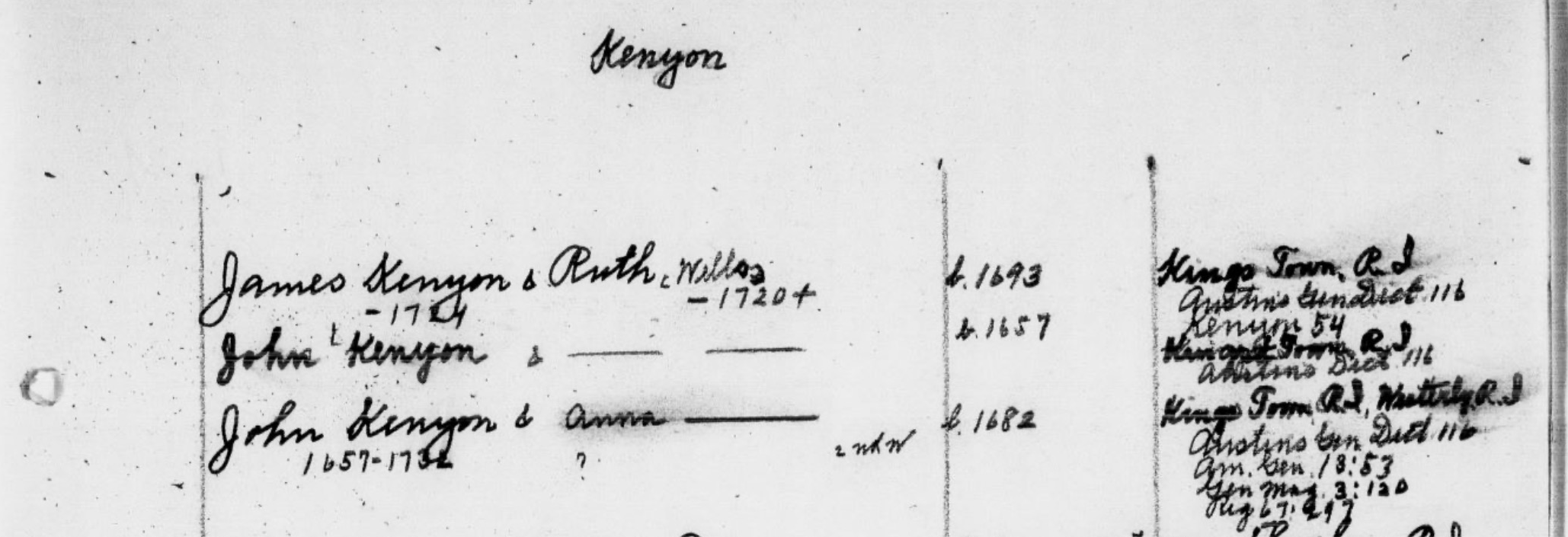
NEHGS has provided a key to the references cited on the right hand column of the entries. Reading down the sources they are: Austin's Genealogocal Dictionary of Rhode Island at p. 116, American Kenyons at p. 54, volume 13 of The American Genealogist at p. 53, volume 3 of The Genealogical Magazine at p. 120 and volume 67 of the New England Historical and Genealogical Register at p. 297. We have already reviewed the information from Austin, American Kenyons and the Colket article in volume 13 of The American Genealogist.
The 1913 article in volume 67 of the New England Historical and Genealogical Register is devoted almost entirely to Roger Kenyon III and his time on Block Island. The article's last sentence refers to John Kenyon as follows: "Shortly after the date of Roger Kenyon's marriage a John Kenyon was at Westerly, R.I., only a few miles from Block Island, and was taxed there in 1687, and from this John the numerous Kenyons of that section are descended." (As we know, the Westerly reference is wrong - it was Kingstown, then known as Rochester.) It has proven impossible at this point to track down the referenced volume of The Genealogical Magazine, but that does not hinder our analysis since there is no information contained in the above entries that is not contained in the sources we have reviewed.
The point to be made is that Torrey's index is not proof that a senior John Kenyon existed or that he was married in Rhode Island by 1657. Torrey's entry is based on Austin's assumption that the John Kenyon born in 1657 had a father named John who had immigrated to Rhode Island. The marriages of John and James on the other hand, with the exception of the name "Anna" as the wife of John, stand to reason since both were on record as living in Rhode Island with families before 1700. The question mark below "Anna" seems to indicate that even Torrey was unsure of the name of John's wife after having read the Colket article.
The James Kenyon Mill Site Grant of 1703 and the Scoundrel Elisha ColeTop
James Arnold identified the mill site deeded to James Kenyon as "the first grant to the mill privilege where Stuart the painter was born afterward." (American Kenyons) Arnold was very familiar with the location because in 1869 his family moved to a farm in North Kingstown near the Gilbert Stuart birthplace, where "Arnold began his life-long practice of visiting local burial grounds to transcribe the information spread across the stones." (Hall of Fame) Arnold's letter provides a grant date of 1670, but the North Kingstown land records show that the heirs and assigns of the original Pettaquamscutt Purchasers granted James Kenyon the mill rights in 1703.
The mill rights became the subject of much controversy long after James Kenyon sold the land and rights in 1705 and it is in those records that the initial deed to James is documented. A January 1725/26 legal proceeding between the Proprietors and Elisha Cole required a summary of the original 1703 grant to James Kenyon. The document states that Thomas Mumford, James Wilson, Henry Gardner and Samuel Sewall by deed "dated the 22nd day of February 1702/03 . . .granted to one James Kinyon of Kings Town . . . millwright" the 120 acre property "with and under the proviso and condition that the said James Kinyon his heirs and assignees should keep up and maintain a grist mill" at the site.
James did not hold onto the property for long. James, along with his wife Ruth, deeded the mill property to Joseph Smith on December 21, 1705. The deed referenced the proviso and condition of the intial deed dated February 22, 1702/03, stating that the grist mill "shall be maintained according to the true intent" of "the original deed given by the purchasers." It appears that Thomas Mumford Jr. was a witness to the deed, although his first name was burned from the surviving document. (Captain Kenyon in reviewing this deed incorrectly gave it the date of the initial deed, rather than the 1705 date. (American Kenyons)
Joseph Smith subsequently sold property to William Gardner on June 3, 1709, which appears to have included the mill site or a substantial part of it. William Gardner on August 25, 1718, sold the property to Elisha Cole. The widow of Elisha Cole sold the property to her son Edward in 1746, who subsequently entered into business and land transactions with Thomas Moffat and Gilbert Stuart, Sr. to operate a snuff mill at the site, which partnership lasted until 1761. (History of Washington and Kent Counties) The surviving North Kingstown land records thus document the intial deed to James Kenyon and the subsequent transactions to include Gilbert Stuart, Sr., which establishes that James Arnold was referring to the same property in his letter as is documented in the North Kingstown records.
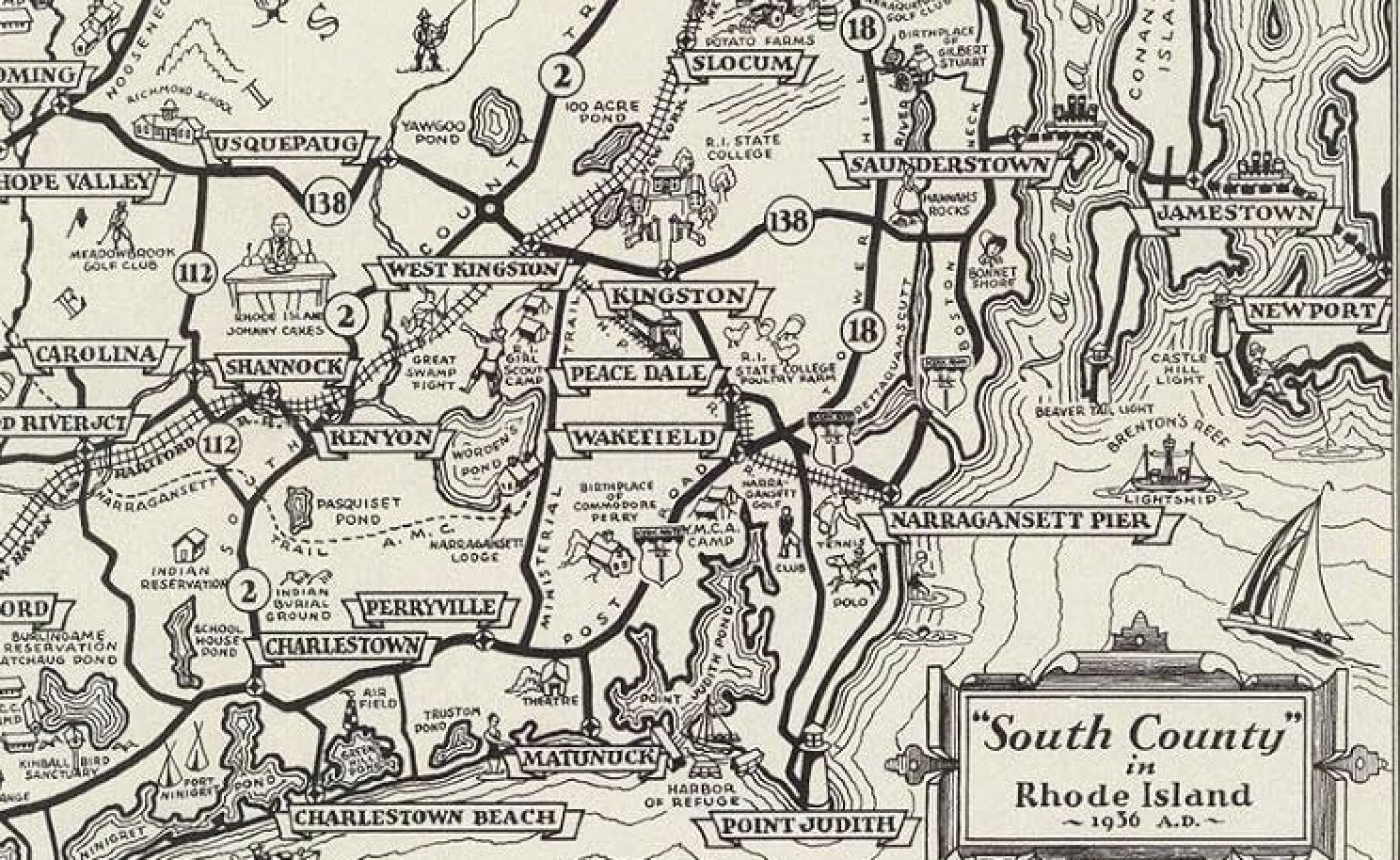 The mill site is above Saunderstown. (Westerly Chamber of Commerce 1936.)
Arnold was mistaken in the year the Proprietors deeded James Kenyon mill rights. He must have been referring to his genealogical notes, which he had compiled over many decades, when he referred to "our Washington Co. records." If he had been referring to actual deeds, the reference would have been to the "North Kingstown Land Records" since property records in Rhode Island are not kept by the county. Gerald Parsons in The American Genealogist similarly questioned the accuracy of Arnold's 1670 deed date. (Parsons at p. 226.)
The limited time James Kenyon held the mill rights also clarifies his occupation during his years in Kingstown and later Westerly. While typically identified as a miller, his principle occupation appears to have been as a livestock farmer. He was granted an ear mark for sheep on May 2, 1700. His will proved on May 4, 1724, listed a herd of sheep, lambs, cattle and oxen. (Austin)
The January 1725/26 legal proceeding involving Elisha Cole bears some mention. In December, 1725, Elisha Cole approached the Proprietors and claimed that James Kenyon and his assigns had "broke the conditions in the [1702/3] deed" by failing to maintain and repair the mill and that it was "now demolished." Consequently, the Propretors in December gave Cole a very broad power of attorney to help them in making sure the property title conditions were met, including the power to bring lawsuits, remove occupants, appoint other attorneys and do whatever was necessary to recover title to the land.
Between December and January, the Proprietrors must have learned that Cole in fact owned the "the greatest part of the one hundred and twenty acres." Their tone drastically shifted. Cole had been granted the power of attorney based on his "false suggestions and insinuations" that he had incurred "great expenses" in looking out for the Proprietors' interests. Cole had "surprised and decieved" them and had been a great cause of the property's "ruination." (At that point he had owned the mill site for over seven years.) He had cared about "his own wrongfull designs and not the interests of us the Proprietors." Needless to say, the power of attorney was retracted.
The Kenyon DNA Surname ProjectTop
The Kenyon DNA Surname Project is a global project administered by Richard Reid Kenyon, Marilyn A. Kenyon and Robert Kenyon. The Project "aims to advance the understanding of Kenyon ancestry by combining documented lineage with genetic advances through primarily Y-DNA testing." (Kenyon DNA Project) Y-DNA testing is the analysis of the male Y chromosome that is passed from father to son virtually unchanged, which allows the discovery of the deep geographic origins of a paternal line. The goals of the Project include: identifying specific Kenyon lines worldwide, identifying the most recent common ancestor between the English lines and those worldwide, identifying migration patterns and assisting members in making DNA matches.
The most significant finding of the Project to date is that there are two unrelated Kenyon lineages that coexisted in Lancashire, England starting in the 13th century, when only one was expected. The first line descends from Jordan de Kenyon (1235–1297). "The second line dates back to around the same period, circa 1220 CE." (WikiTree - Kenyon Name Study) The Rhode Island branch descends from the second line and is identified with Haplogroup R-A6342. (Additional proof that John Kenyon was not a descendent of the Kenyons of Peel Hall.) The Project's DNA results show that the "man who is the most recent common ancestor of the R-A6342 line is estimated to have been born around 1649 CE." (Kenyon DNA Project) In view of the unlikelihood of finding a documentary link between the Rhode Island branch and its English roots, the Kenyon DNA Surname Project may be the best chance of achieving that goal.
Dead EndsTop
There are several avenues of inquiry into early Kenyon colonial genealogy that seem to lead nowhere. One is that Thomas Mumford Jr.'s wife Abigail was John and James' sister. This assertion is made without any documentary support. Thomas was married to an Abigail, but her maiden name is unknown. (Mumford Memoirs) The basis for the claim seems to be that the families were close and there were few eligible candidates for marriage in that area of Rhode Island at the time.
Abigail became well known after her marriage to Thomas Mumford Jr. because of the circumstances of her death. She was killed at her home in May, 1707, by a man enslaved by the Mumfords. Abigail "had some words" with the man and had him whipped. He responded by striking and killing her. The story was that he realized his cause was hopeless so "in the end he threw himself into the sea and was drowned." (Mumford Memoirs) This was an unsatisfactory ending as far as the Rhode Island Assembly was concerned so they decreed: "the said negro's body being brought into the harbour of Newport, it is ordained by the Assembly that his head, legs, and arms be cut from his body and hung up in some public place, near the town, to public view; and his body be burned to ashes, that it may, if it please God, be something of a terror to others from perpetrating of the like barbarity for the future." (Colony Records)
There was actually a wife in Massachusetts then whose maiden name was "Kenion" and she was married to land speculator Humphrey Atherton. Mary Kenion of Winwick Parish, Lancashire married Humphrey Atherton in England before they immigated circa 1635 to Massachusetts where they made their home. Mary died in Dorchester in 1672. Her father was named James and her brother Peter had an eldeset son named James born in 1635, but who remained in England, dying there in 1679. Her nephew James was therefore not the progenitor of the Kenyon family of Rhode Island. Based on her Winwick Parish place of birth in Lancashire, she was also likely of Kenyon DNA lineage I.
There is also lore that Roger Kenyon II sent John and James Kenyon to rescue Roger III from his indentured servitude. This seems solely based on the the presence of all three in Rhode Island in the 1680s and nothing more. The Kenyon Manuscripts show that in fact Roger II engaged Captain Shapley to retrieve his son from the colonies. And he also sent William Hayhurst, who was charged with finding Roger III at Plymouth and who, on March 24, 1683/84, wrote to Peel Hall explaining that he was unsuccessful in finding him there. (Kenyon Manuscripts) John Kenyon was already in Rhode Island by 1677 in any event.
SourcesTop
Books/Articles/Reports
Austin, John Osborne. The Genealogical Dictionary of Rhode Island. Joel Munsell's Sons 1887. ("Austin")
Beckles, Hillary McD.. "The 'Hub of Empire': The Caribbean and Britain in the Seventeenth Century." The Origins of Empire. Oxford University Press 1998. ("Origins of Empire")
Beebe, Randolph R.. Cross Reference: Gov Andros 1687 Rochester Tax Register to Wikitree Profile. WikiTree, 27 Jan 2024. ("1687 Rochester Tax Register")
Bicknell, Thomas Williams. The History of the State of Rhode Island and Providence Plantations. The American Historical Society Inc. 1920.
Brown University. "Slavery, the Slave Trade and Brown University." Slavery and Justice Report. Brown University 2006. ("Slave Trade")
Cady, John Hutchins. Rhode Islands Boundaries 1636-1936. Rhode Island Tercentenary Commission 1936.
Campbell, Meredith. The English Yeoman Under Elizabeth and the Early Stuarts. The Merlin Press 1960. ("The English Yeoman")
Cole, J. R.. History of Washington and Kent Counties, Rhode Islands. W. W. Preston & Co. 1889.
Colket. Meredith. "The Wife of the First John Kenyon of Rhode Island." The American Genealogist, vol. 13, 1936, pp. 53-55, americangenealogist.com.
Fiske, Jane Fletcher. Rhode Island General Courts of Trials 1671-1704. Boxford, Massachusetts 1998.
Hailwood, Mark. ""The Rabble that Cannot Read'? Ordinary People's Literacy in Seventeenth-Century England." Past & Present, August 3, 2023. ("The Rabble")
Hailwood, Mark. "Rethinking Literacy in Rural England, 1550-1700." Past & Present, August 1, 2023.
Historical Manuscripts Commission. Fourteenth Report, Appendix, Part IV - The Manuscripts of Lord Kenyon. Printed for Her Majesty's Stationary Office, By Eyre and Spottiswoode 1894. ("(Kenyon Manuscripts")
Joel Munsell's Sons. American Ancestry: Giving the Name and Descent, In the Male Line, of Americans Whose Ancestors Settled in the United States Previous to The Declaration of Independence A.D. 1776. Joel Munsell's Sons 1887.
J.H. Beers & Co.. Representative Men and Old Families of Rhode Island. J.H.Beers & Co. 1908.
Kenyon, Howard N.. American Kenyons. The Tuttle Co. 1935. ("American Kenyons")
Kenyon, Richard L.. The Kenyons of Cattaraugus, NY. Painted Hills Genealogy Society 2014. ("Kenyons of Cattaraugus")
Lockridge, Kenneth A.. Literacy in Colonial New England. W.W. Norton & Co. Inc. 1974.
Mingay, G.E.. The Gentry: The Rise and Fall of the Ruling Class. Longman 1976. ("The Gentry")
Moriarty, George Andrews, Jr.. "Notes July, 1913." The New England Historical and Genealogical Register, Vol. 67, 1913.
Moriarty, George Andrews, Jr.. "The Heir of Lancashire House." Colonial Society of Massachusetts December, 1932. ("The Heir")
Parsons, Gerald J.. "Enigmas #17: Revisiting the English Origin of John and James Kenyon of Rhode Island." The American Genealogist, vol. 78, 2003, pp. 222-227, americangenealogist.com. ("Parsons")
Romani, Daniel A. Jr.. The Pettaquamscutt Purchase of 1657/58 and the Establishment of a Commercial Livestock Industry in Rhode Island. Boston University 1995. ("Pettaquamscutt Purchase")
Russell, Judy G.. "Part 1: How Old Did Folks Have to Be." The Legal Genealogist, 17 Jan 2012.
Torrey, Clarence Almon. New England Marriages Prior to 1700. New England Historic Genalogical Society 2011, americanancestors.
Tyrell-Kenyon, Lloyd. The Annotated Kenyon Family Biography. Lloyd Tyrell-Kenyon 2015. ("Kenyon Biography")
Whitney, Mary Taylor. "The Lure of Probate Records." Facts and Fancies Concerning North KIngstown, Rhode Island. Pettaquamscutt Chapter, D.A.R. 1941. ("Probate Records")
Wood, Michael J.. "Enigmas #17: Revisiting the English Origin of John and James Kenyon of Rhode Island (continued from vol.78)." The American Genealogist, vol. 79, 2004, pp. 207-208, americangenealogist.com.
Worthington, Dorothy. Rhode Island Land Evidences Volume 1 1648-1696 Abstracts. Rhode Island Historical Society 1921.
Web Sites
Archives Hub. Jisc. 1999-present.
FamilySearch. Church of Jesus Christ of Latter-day Saints. 1999-present.
Guild of One-Name Studies: Kenyon One-Name Study. Guild of One-Name Studies CIO. 2013-present.
Kenyon Name Study. WikiTree. The WikiTree Company. 2008-present.
The History of Parliament - Kenyon, Roger (c.1627-98), of Parkhead and Peel Hall, Lancs.. History of Parliament Trust. 2011-present.
The Kenyon DNA Surname Project. FamilyTreeDNA. Gene By Gene, Ltd
The Legal Genealogist. Judy G. Russell. 2012-present.
Town of North Kingstown, Rhode Island. 2018-present.
Government Archives
Kenyon Family of Peel Hall, 1319-1960. Lancashire Archives.
Rhode Island Land Records No. 1, 1648-1696. Secretary of State of Rhode Island.
Roger Kenyon [Roger III] (Roger Kenyon's eldest son), Road Island - begging his father.... National Archives.
TopThe image at the top is from the 1677 property execution.
The author of Who Was the First Kenyon Ancestor in Rhode Island? is Todd Kenyon.
©2026 Todd Kenyon. All rights reserved.